Time II: The light in Hell as evidence of the Now
Either way: fire of punishment and rays of salvation
Continuing with the temporal structure: in the Hell of the Garden of Earthly Delights, Satan/Lucifer is to be identified as the Prince of Hell who devours and excretes souls. This could mean that we are already in the Hell of eternal damnation, after the Last Judgement. However, his feet are ‘stuck’ – in two jugs, to be precise. This may be a new metaphor, but it also evokes the binding of Satan before the Last Judgement.
At the same time, there are indications that the Judgement is just about to take place, or cannot have taken place long ago – or that the Hell panel, too, is not a depiction of a specific point in the history of creation, but its interpretation. Satan is handicapped, yet he accomplishes his evil work, and at the same time – something that has been overlooked so far – hope of salvation is already being conveyed.
In images of the Last Judgement, right up to modern times, up to the nineteenth century, the saved are bathed in bright light. There is such a group on the Hell panel of the Garden of Earthly Delights as well. So that it is not overlooked, the painter has set a contrast against it. These are the light effects on the far right, at the upper edge of the middle third of the picture – where the populated middle zone passes over into the devastated, burning landscape of the background.
Two luminous phenomena rising diagonally to the right are staged as parallel events – they are meant to be compared. In both cases the luminous phenomenon is ordered in a rhythm of three. First of all, two bright patches of light catch the eye. The upper one is at an archway; almost directly beneath it something is ablaze, the fire glowing red and yellow.
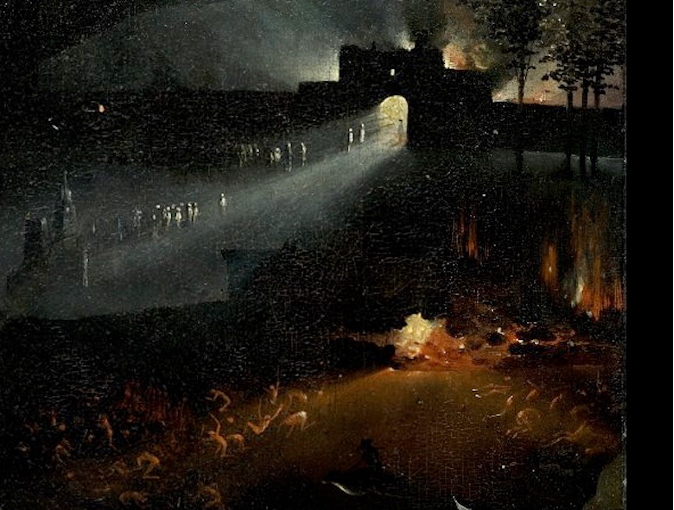
In both cases the patch of light forms the centre of a gradient of light. On the right, each gradient begins slightly higher up as a vertical grid of light and dark (above: formed by trees). To the lower left of each centre, the light falls on groups of people. The lower ones, somewhat larger than those above, are violently agitated: they gesticulate, they writhe or have fallen on their backs. The group above, lit from the archway, stands calmly in the light.
Like two lateral echoes, there is in each case a confirmation of the divergent character of the two gradients of light. In the case of the beam of light through the archway, people stand calmly above the cone of light, too, in front of the dark wall. Below, starting from the yellow-red fire, recumbent and writhing figures form a reddish-brown streak running down to the right.
In the manner just sketched, the fortunate saved and the unfortunate condemned are often distinguished from one another in Last Judgements. The despair of the latter is expressed as violent facial expression and body language.
Can anything else be meant on the Hell panel? Anything other than indicating that some are condemned and the others saved? One must always try to imagine the painter’s decisions. What could have prompted him to lay out two gradients of light in three steps? Could it be a coincidence, merely following decorative requirements? An explanation on purely painterly grounds does not suffice, for it would not account for the contrast between the body language above and below.
The matter becomes clear when one notes how the two gradients of light differ from each other as light. Then the Temptation of St Anthony in Lisbon confirms the supposition that the upper light in the Bosch Garden bears witness to salvation.
In the upper gradient of light on the Hell panel, the one through the archway, the light has rather few red components; it is colder, sharper, brighter. In the lower gradient, fire dominates, rendered – as in the burning landscape at the back – in intense red and yellow. To the left and right of the centre, too, the markedly warm light below is less bright.
A comparison with the Anthony in Lisbon (complete views, for example, on Wikipedia) helps further. On the left, behind the tower, there is a fire; a ridge turret is just falling victim to the flames. Further to the left, the temperature of the light no longer changes: the light remains fiery, red, blazing. Only on the right, behind the ruinous tower, is the light closer to white – brighter and glaringly cold.
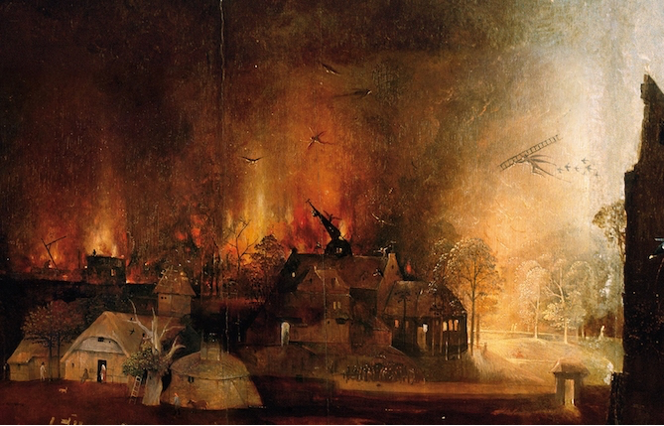
Remarkably, in the Lisbon background, on the left, in the zone of the warm yellow-red fire, everything is ablaze and houses are collapsing. To the right of it, by contrast, nothing is burning in the bright, cold light. Even the trees at the boundary of the light are undamaged.
‘What manner of spirit’ the bright light is of can be recognised in the Lisbon painting not yet at the archway, but only on account of a very slender detail near Christ in the foreground. The following illustration continues the previous one towards the lower right. The light behind the small gate in the wall – there expressly the bright, glaring light – evidently continues to radiate diagonally forward. It penetrates through an opening in the tower into the small room with Christ. He is giving a blessing and presumably stands at an altar with a candle and a crucifix on it. One almost has the impression that the light strikes him from behind.
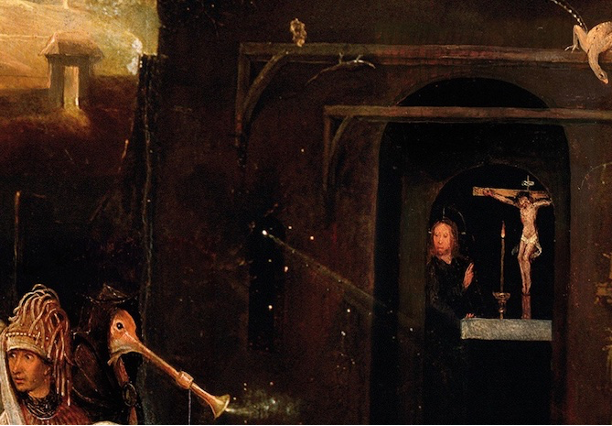
The beam can just about be made out as a faint parallel to the beak of the devilish instrument. It evidently comes from the gate in the wall, enters through a bright hole in the wall of the tower and widens slightly the further it falls towards the altar.
Would it make sense for Christ to be informed, as it were from behind, of heresy and calamity by the beam of a devilish conflagration – or even to be teased by evil? No, both would thoroughly contradict divine greatness, inviolability and omniscience. Only the reverse case makes sense: the Holy Spirit is at work even in the greatest danger, out of the greatest destruction, and here, as it were, enters the holy chapel. It is expressly the bright light behind the small gate in the enclosure that is given a role in the foreground.
Returning to the Garden of Earthly Delights, the conclusion can be brief. As long as one considers only the luminous phenomena there, one may still doubt that they put salvation versus damnation into the picture. If one adds the Lisbon Temptation of St Anthony, the argument of the light on the Hell panel of the Garden of Earthly Delights can no longer be overlooked.
In both paintings the light emerges from a kind of religious architecture, conceivable as a monastery courtyard with a wall. Where it illuminates the saved on the Hell panel of the Garden of Earthly Delights, one might also make out a (very small) chapel in the darkness. In a broader sense, then, one may understand that only religious participation protects from condemnation at the Last Judgement. Better still to belong to an order, a monastery.
With regard to the temporal order, it should be noted that Satan has already begun the eternal torment of Hell, but that Hell juxtaposes rescue and condemnation as a contrast. Thus one might possibly place the moment of Hell at shortly before the Judgement: the heavenly light announces the Redeemer.
It should be just as important to note that Hell presents precisely the second of decision that is staged on the central panel: we are at the second of the sinful soul’s awakening in the so-called cave, in the flap of a wing before Heaven or Hell.
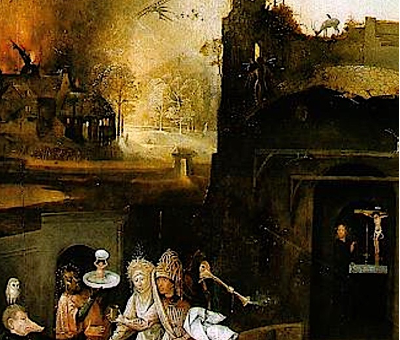
Garden of Earthly Delights and Temptation of St Anthony: fire of condemnation and light of salvation.