Further objections and wrong turns
The Garden of Earthly Delights and the new ‘Promethean shame’
The website of the Bosch Centre in ’s-Hertogenbosch, Closertobosch.nl, which went live in 2025, is based on the findings of the Bosch Research and Conservation Project (BRCP). There is nothing new to be learnt there about the Garden of Earthly Delights. Unfortunately, as a jealously guarded Prado possession, the painting was not available for this magnificent undertaking. The most impressive results of the BRCP are the analysed macro-photographs and other records of underdrawings and paint structure, along with a multitude of paint and other material studies. This is not meant as carping. These are findings that leave the technological layperson utterly astounded, since he or she often does not understand the reasoning behind them, let alone verification. Even drawing one’s own conclusions from them is risky.
Luuk Hoogstede’s doctoral thesis, based on his work for the BRCP, has also been published as a book: Jheronimus Bosch, Conservation and Restoration. From Former Glory to Changing Appearances, Turnhout: Brepols, 2025. Undoubtedly a marvellous treasure trove. In it, Hoogstede expresses scepticism as to whether the surface of the Garden of Earthly Delights can still be trusted. He is also quite critical of his predecessors. Time had taken a heavy toll on the painting, as old photographs show. It seems that some wrong turns were also taken along the way.
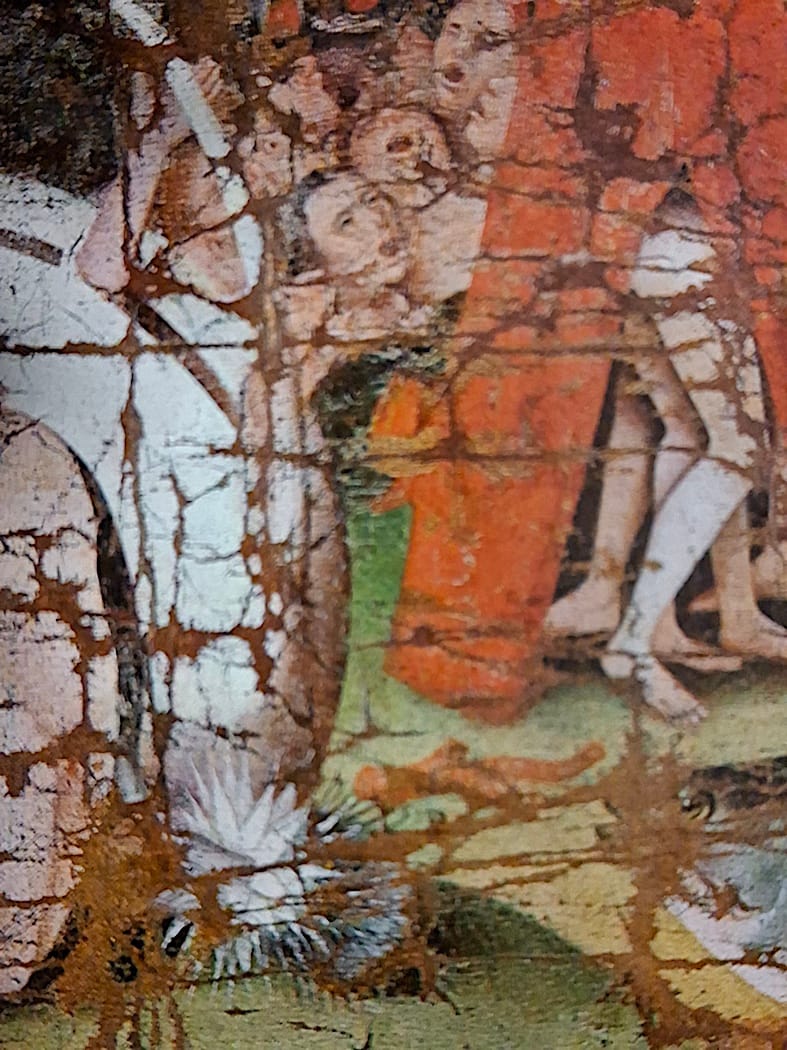
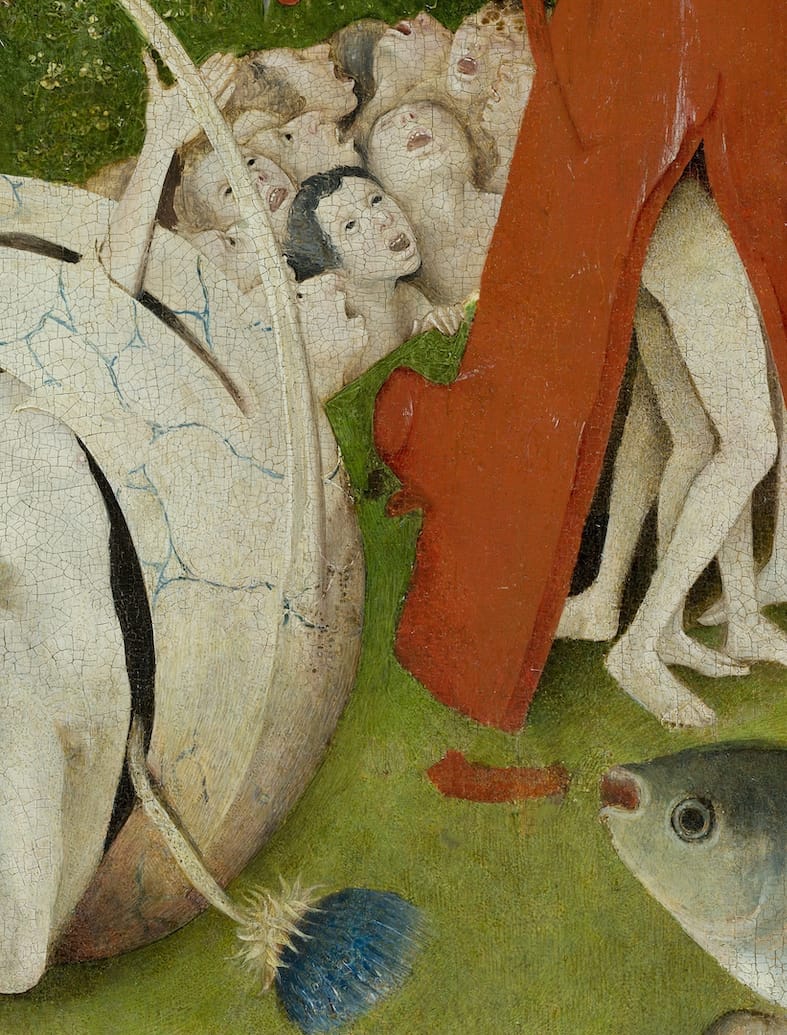
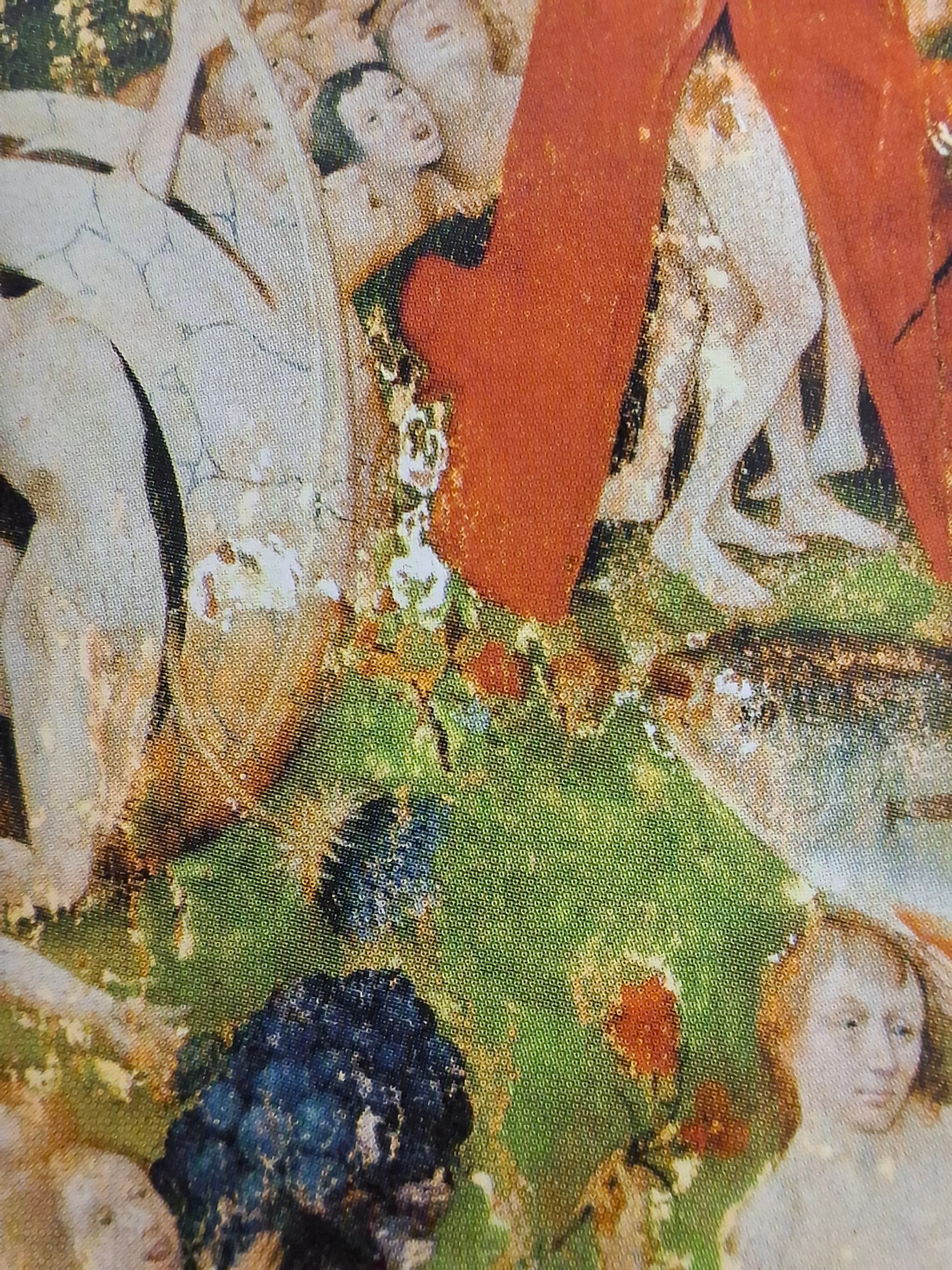
Fragment and ruin (left) with a recognisable branch. On the right, the Prado painting before and after the 2000 restoration (from Pilar Silva Maroto, El jardín de las delicias de El Bosco: copias, estudio técnico y restauración, Madrid, Museo Nacional del Prado, 2000).
As for the curious red streak beneath the tree-tent (current state in the centre), the restorers were apparently at a loss. Actually, one cannot really identify the red patch beneath the tent, and one initially wonders what the fish is snapping at there. Before the latest restoration, it even appears that a flower had been ‘placed’ there (right, small). It was removed. The patch of colour only makes sense when one recognises it as one of the branches that have been sawn off at the top of the ‘tree’ – as can still be seen in the ruinous Budapest copy (left, and in better copies in private collections). The restorers evidently did not wish to recreate such a form for the Prado painting, which is entirely understandable.
The paint layer had suffered most in the area of the ‘little paradise’ on the right-hand edge; fortunately, mostly in the fruit. By contrast, the figures’ postures remain recognisable. Unfortunately, the damage also affects an ‘agnatic branch’, which rises from a wrist at the diverging ‘marriage emblem’ – still a puzzle at this point – more on that later. Overall, however, I am not quite as sceptical as the restorer that the Garden of Earthly Delights cannot be unravelled due to its physical condition.
Fortunately, Bosch research does not adhere to the verdicts that the Garden of Earthly Delights, as a mere topsy-turvy meant to be as fantastical and inventive as possible, cannot be understood at all. Yet without underestimating the stimulating observations in the books by Rosa Alcoy (2020) and Margaret Carroll (2022): what currently seems to be advancing most rapidly are the technical possibilities for investigation. The BRCP already congratulated itself, quite rightly, on its amply technological investigation being the ‘new kind of art history’. Nevertheless, this did not lead to any convergence of views, for example, regarding the ‘second Bosch’. Fritz Koreny, drawing on traditional ‘connoisseurship’, had established a ‘Master of the Prado Haywain’ and attributed key works to him. A consensus – or at least a convergence of views – remains elusive; the more advanced technological analyses have done nothing to help.
The interpretation communicated from on high carries greater credibility, whether from the BRCP or from New York, Nijmegen, Cambridge, etc. – the ex cathedra principle. This is a delicate matter for someone speaking entirely from the sidelines. I have already encountered such mistrust: not only without an institutional affiliation, but also without a career in art history – It’s just his hobby! And worse still: a journalist who isn’t too particular about his sources! And then, on top of that, from eastern Germany – good God – and trained in the GDR, the devil you say! How can anyone believe someone like that! No, please, believe only your own eyes and your own reason – certainly not any authority.
What next? Wait for the next camera that separates the layers of paint even better? For the next image-analysis method? Perhaps we really should wait until image recognition has advanced so far – not just for cancer, but for older paintings – that all errors and all disputes are over, because any well-reasoned human argument can only turn out to be an error later on? Perhaps we have been preparing for this wait for a long time? As early as with the diagnoses that the painting was not made to be understood linguistically and intellectually at all?
Doesn’t the preference for technology in recent years point precisely in this direction? Has the new ‘Promethean shame’ – to use Günther Anders’s incredibly topical term – has this blanching before the ‘super-being that is technology’ also caused efforts to achieve an intellectual understanding of the painting to wane? A research project is needed to feed AI with all the Dutch, French, German and Latin textual and visual material that might in any way be relevant.
Unfortunately, I can neither wait for nor trust in this, and so, as an alternative to the Transhuman Turn, I proclaim the Eudaimonic Turn for the Garden of Earthly Delights. Let us enjoy the last days of the thinking granted to us; let us allow the good spirit to wander through the triptych, to put good living and good loving to the test. In this respect – see Coffee or Vineyard – I know myself to be at one with the Garden of Earthly Delights.