The Musical Hell
Sonorous aspects of a vision of doom: the Hell panel
Hell, in particular, is best explored with caution. The Tree-man does not yet play a role here, nor, for that matter, does the way in which Psalm 68 (Vulgate) – the enemy psalm, or imprecatory psalm – is infamously used in Hell. To begin with, I shall take a somewhat more measured look – Bosch will be forceful enough in his own right – at what Hell might have to say about music.
As with many details of the Garden of Earthly Delights, there is no consensus regarding the meaning of the ‘Musicians’ Hell’. The term ‘Musicians’ Hell’ was coined by Wilhelm Fraenger (1890–1964). His designation may allow us to discuss the area at the front left of the right-hand panel of the triptych separately. In the vicinity are Lucifer, the Prince of Hell; the gambling hell; the Tree-man; scenes of satirical and political theatre; and, in the background, the burnt-out world of the Apocalypse (with a well-hidden prospect of salvation). All of this is set aside for the time being.
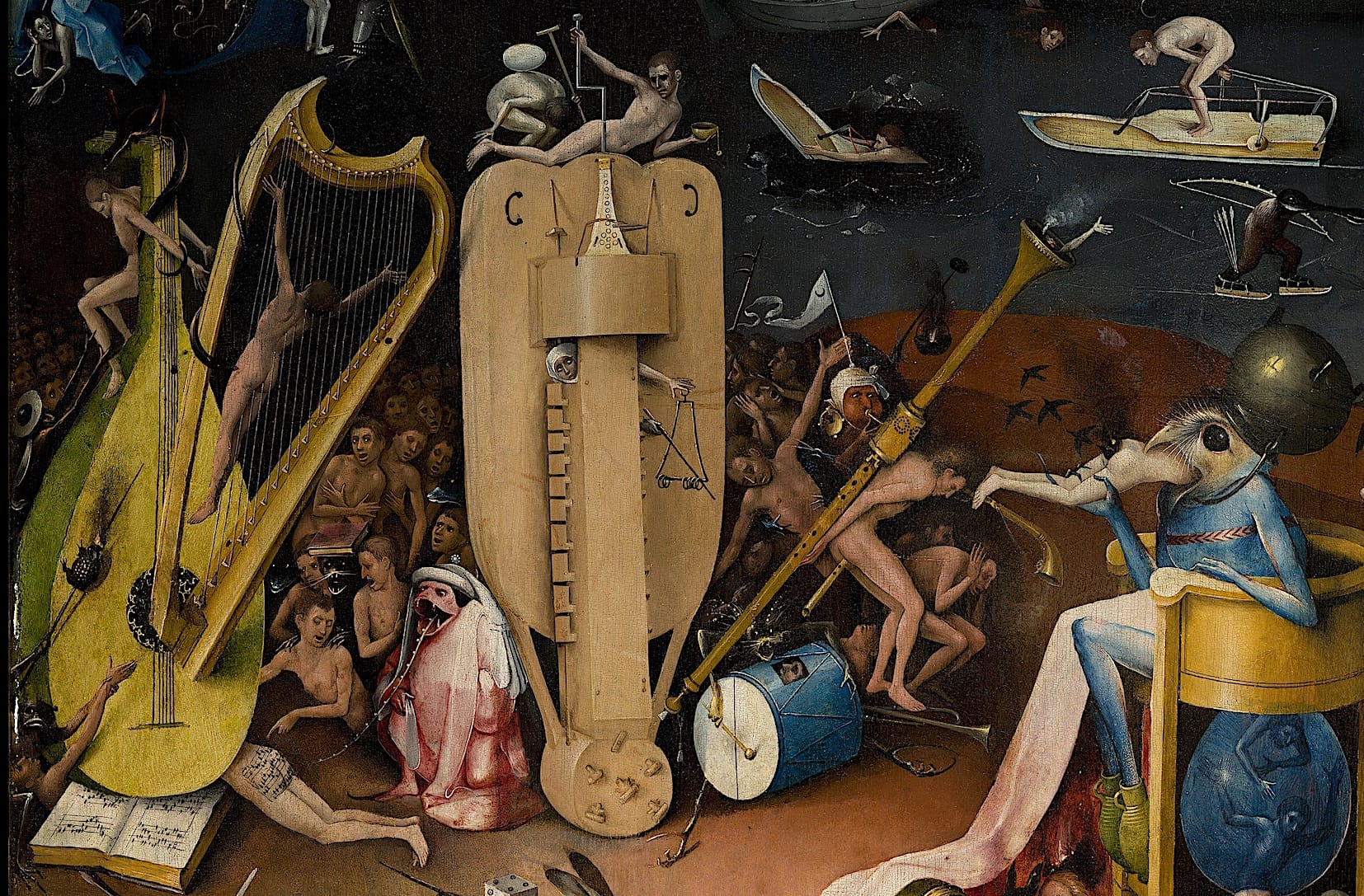
First of all, the four enormous instruments catch the eye: the lute, the harp, the hurdy-gurdy and the tenor shawm (bombard). Crowded around them are three groups of the damned – two of them larger – intermingled with their tormentors. Torment takes place at the harp and the lute. At the harp, the figure’s posture evokes the image of a man crucified. This is emphasised by the figure next to him, who is bound to the lute. Together, the two appear like Christ and the bad thief in a crucifixion scene. The smaller group on the far left can be seen as the audience of the crucifixion.
A similarly enormous serpent anchors the harp to the lute at the bottom and the ‘thief’ below the lute’s bend at the top. This allusion to a crucifixion – unusual for a depiction of Hell – has also been linked to the Old Testament figure of David – the harp being his symbol, and he a forerunner of Christ – and even to Jubal, who, according to the Book of Genesis and later interpretations, was the inventor of musical instruments. But why, then, would the scene be so steeped in the Fall and punishment?
To the right of the harp, several men – one of whom appears to be shivering – are evidently being urged to sing by devils. The figure in the reddish fantasy costume, with his back to the hurdy-gurdy, might be taken as the ‘cantor’. The nature of the singing is conveyed by the figure’s hideous, animal-like appearance and the chain connecting the wide-open, fish-like mouth to the musical notation on the backside of the man wedged between the lute and the choir book.
The large hurdy-gurdy, also known as a ‘symphonia’, continues with three small figures who are unable to play it; one is turning the crank at the top. To the right of the hurdy-gurdy, there is no singing; instead, the figures are handling instruments. There, the music seems to torment them more urgently, and here too there are devils present. Two victims of Hell are covering their ears; one, trapped inside the drum, is being acoustically tortured by the beating, whilst another is playing the recorder anally.
The very division into a group of singers and a group of instrumentalists is likely to suggest that the music of this Hell must, at least in principle, be understood as a reversal of religiously positive music. In the Ghent Altarpiece by the van Eyck brothers, the most beautiful singing angels on the left and instrumental angels on the right offer a hymn of praise to the trio enthroned in the centre: Christ as God, Mary and John the Baptist. Bosch forms a two-part choir from these two groups, which marches before Lucifer, who, to this accompaniment, devours and excretes human flesh at piecework pace.
The scene is thus a caricature of all the calls – for example, in the Psalms – to ‘sing a new song to the Lord’. Those condemned to this in Hell have evidently failed to do so in their lives, or have done so half-heartedly, ‘with their lips alone’, and are now tormented with a punishment that mirrors their offence.
Reindert L. Falkenburg’s reference to Psalm 33 is fruitful. The psalm begins with the verses: ‘Sing joyfully for the LORD, you righteous; it is fitting for the upright to praise him. Praise the LORD with the harp; make music to him on the ten-stringed lyre. Sing to him a new song, play skillfully, and shout for joy.’ (NIV) In Hell, the opposite is practised – not before God, but for the Prince of Hell.
Alongside the division between choir and instrumentalists, another distinction stands out, this time concerning the music. In the Franco-Flemish chapels – which had existed in astonishing numbers, and presumably also of astonishing quality, since the 15th century – it had become customary to divide instruments into loud, powerful ones on the one hand and soft ones on the other. The chapel master, the ‘premier chapelain’, who was sometimes still both a cleric and a musician, was in charge of the ‘hauts instruments’ – primarily wind instruments – and the ‘bas instruments’ – chiefly string instruments. In ‘Musicians’ Hell’, the soft instruments – the lute and the harp – are on the left, and various loud instruments on the right: the great bombard, the recorder, the bass drum and various brass instruments.
Musically speaking, this essentially results in a great many discordant notes – or the instruments remain silent. With the lute and harp, it is obvious. Their output is torture, perhaps accompanied by a discordant chord when snakeskin brushes against the strings. The great bombard may be blown with puffed-out cheeks, but it is blocked at the top. The drum cannot produce a sound with its occupant inside; the hurdy-gurdy – its strings are barely visible – produces, at most, a monotonous drone, if the beggar manages to turn it from above. The recorder player’s flatulence will not allow for anything more refined either. A devil’s reaching for the triangle – a dark hand strikes it instead of the hand of a nun peering out from above – must generally be viewed with suspicion. Which here, once again, means: the devil is ‘beating time’ for her. And from the downward-curving cornett (or horn) on the far right, smoke apparently streams out instead of a tone. Finally, the trumpet on the ground is even being trampled underfoot.
This might come as a surprise, for in fact the music of Hell is the opposite of the harmonious music of Heaven – that is to say: loud, chaotic, dissonant, cacophonous; in any case, the proverbial ‘infernal din’.
However, the fact that all artistic, luxurious, worldly sounds die away is a prominent feature of the apocalyptic punishment. Chapter 18 of the Book of Revelation recounts the downfall of the city of Babylon. Within an hour, God causes Babylon to sink. A mighty angel picks up ‘a boulder the size of a large millstone’, throws it into the sea and cries out: ‘With such violence the great city of Babylon will be thrown down, never to be found again. The music of harpists and musicians, pipers and trumpeters, will never be heard in you again.’
The musicians are explicitly named. By silencing them, Bosch would have staged music in keeping with Hell as a whole. Hell is the ultimate apocalypse. The sinner subjected to the most radical punishment, the Tree-man, is transformed into a pre-human level of soul – a mixture of plant and animal – the exact opposite of the ‘image and likeness’ of God that wins the Kingdom of Heaven (more on this later).
If the ‘Musicians’ Hell’ was conceived along these lines, then perhaps at least as an impulse? For two of the punished instrumentalists are covering their ears, so there are sounds! Might one envisage a hybrid form, something like a final, dying discord? Then one could understand the torments involving musical instruments as a drastic, yet logical, religious argument.
However, almost exclusively hellish music appears in Bosch’s entire oeuvre, and when it does appear outside of hell, it is only in connection with a temptation to sin. The question of whether a personal aversion also resonates in his depiction of music seems justified. But when, and with which themes and subjects, would he have had the opportunity to depict music in a positive light?
Moreover, it is always risky to draw conclusions about a painter’s convictions from medieval images. Often, advisors drafted the concepts for elaborate works. Admittedly, Bosch’s power of imagination is so great – and, above all, so visually concrete and striking – that one doubts whether a theologian or poet could have devised something that the painter merely had to illustrate.
The history of the period and the little that is known about the painter’s life may shed some further light on Bosch’s relationship with music. For the painter may also have had dealings with music and musicians in a position of responsibility. Coming from a family of craftsmen, he had – it is a mystery what he had to offer – married the wealthy heiress Aleid van de Meervenne in 1481. Five years later, he became a member of the Illustre Lieve Vrouwe Broederschap, the Brotherhood of Our Lady at St John’s Cathedral in ’s-Hertogenbosch, the city’s main church.
Presumably buoyed by the social status he had attained through marriage, he became a so-called ‘sworn member’ a year later, thereby joining an elite circle of several dozen men, most of them aristocrats, newly wealthy patricians, notaries, clergymen and apothecaries. They managed the affairs of the brotherhood, which had several thousand members well beyond the region. Around 1500, the brotherhood focused on prestige and admitted many nobles from the northern Netherlands, including Duke Philip the Fair. Whether Bosch, the painter of the elites, was in fact responsible for church services as a ‘sworn brother’, as the brotherhood’s statutes would suggest, is impossible to know. His presence at such services is, however, almost certain.
What sort of music did he listen to – and with what delight? Music had been highly cultivated in the city since the early 15th century. The cathedral possessed a magnificent organ, and the church chapter had begun to employ qualified singers directly. By 1470, six professional singers were already employed, joined when necessary by itinerant singers and boy trebles. The most famous permanent singer was the composer Pierre de la Rue (c. 1452–1518), whose works are still performed today and who, alongside Josquin des Prez, is regarded as a key figure in the refinement of polyphonic music. He was in ’s-Hertogenbosch from 1489 to 1492 and from there moved to the Burgundian court chapel, which at that time was still under the authority of King Maximilian until Philip the Fair came of age in 1494. Petrus Alamire (1470–1536), who later became famous as a calligrapher, music copyist and producer of magnificent choir books for the whole of Europe, belonged to the ensemble in ’s-Hertogenbosch in 1496/97, presumably as a lute player.
This, then, is the question that may perhaps also have been decisive for the now-famous ‘butt music’: what was Bosch’s relationship with the still relatively new polyphonic music – especially as Mass continued to be celebrated in the ‘Gregorian’ style in the other churches in ’s-Hertogenbosch?